
2006 — TATTOO FLASH MAGAZINE
MOVING ON — OTTE TIMAR
Tattoo Flash, July 2006
Text: Michelle Delio
Last year, on a rainy summer day, Otte Timar was sitting in his newly built studio in Kassel, Germany, sadly planning his exit from the country. He had just opened the business, but it had quickly become clear to him that this new life wasn't going to work out as he'd hoped and planned.
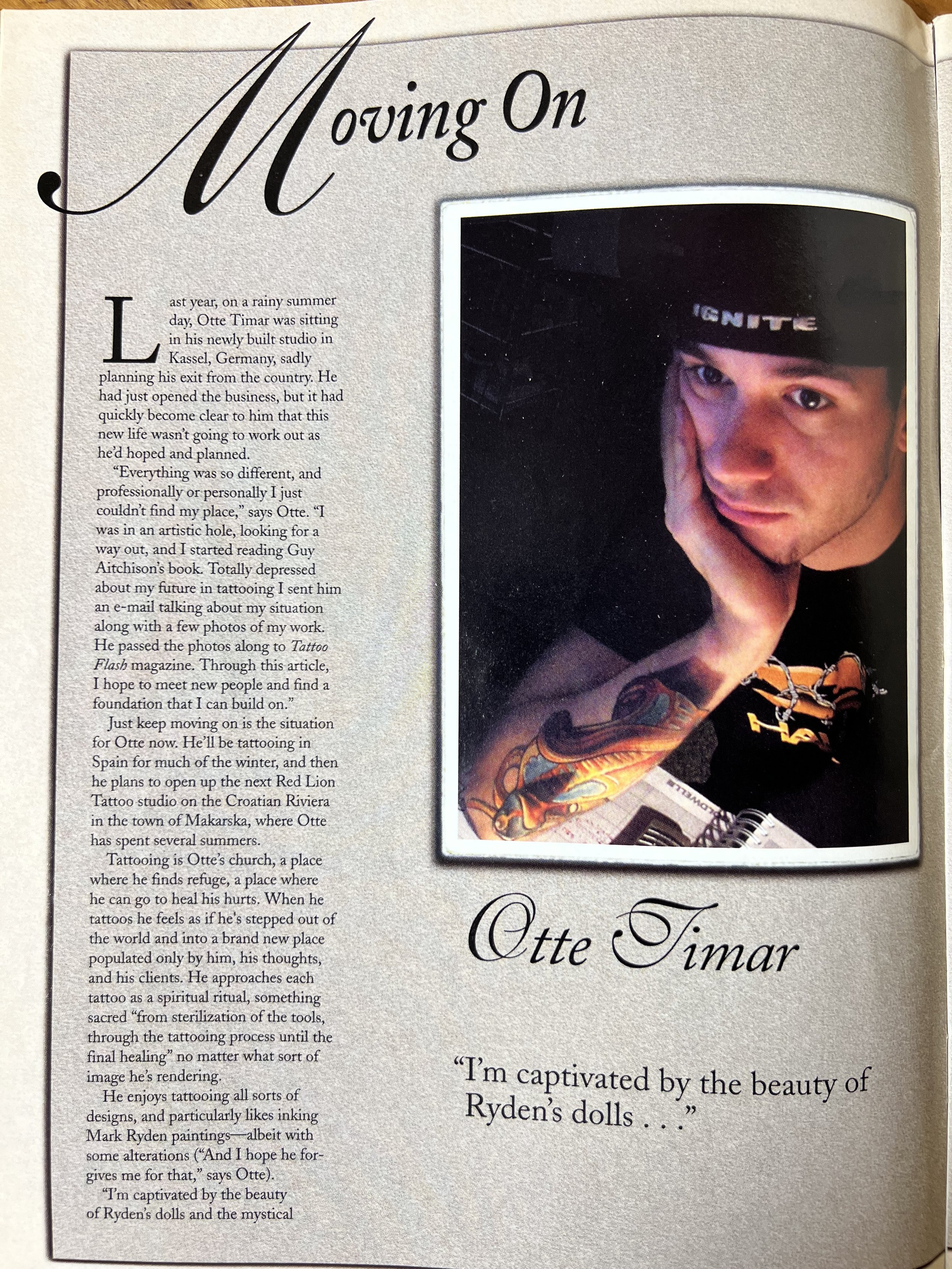
“Everything was so different, and professionally or personally I just couldn't find my place,” says Otte. “I was in an artistic hole, looking for a way out, and I started reading Guy Aitchison's book. Totally depressed about my future in tattooing I sent him an e-mail talking about my situation, along with a few photos of my work. He passed the photos along to Tattoo Flash magazine. Through this article, I hope to meet new people and find a foundation that I can build on.”
Just keep moving on is the situation for Otte now. He'll be tattooing in Spain for much of the winter, and then he plans to open up the next Red Lion Tattoo studio on the Croatian Riviera in the town of Makarska, where Otte has spent several summers.
Tattooing is Otte's church, a place where he finds refuge, a place where he can go to heal his hurts. When he tattoos he feels as if he's stepped out of the world and into a brand new place populated only by him, his thoughts, and his clients. He approaches each tattoo as a spiritual ritual, something sacred “from sterilization of the tools, through the tattooing process until the final healing” no matter what sort of image he's rendering.
He enjoys tattooing all sorts of designs, and particularly likes inking Mark Ryden paintings—albeit with some alterations (“And I hope he forgives me for that,” says Otte).
“I'm captivated by the beauty of Ryden's dolls and the mystical background content with some psycho-seasonings. Other than that I also enjoy religious themes. Mainly I'm interested in angels. I sometimes hear them,” says Otte.
About the only imagery he doesn't like doing are negative symbols and malicious images. His approach to life is from a spiritual perspective, and he feels uncomfortable about “dressing someone in such images for their entire life.”
And Otte doesn't do tribal work anymore—a career advancement that makes him very happy. “A couple of years ago I worked in a shop where doing half a dozen tribal pieces daily was the norm. I couldn't stand that for long. I prefer to work together with the client to find the image. The client gives me an idea, and I use my intuition to develop it. This way everyone is satisfied in the end,” says Otte.
Otte feels that sometimes he overcomplicates tattoos, trying to make them more detailed than they need to be. As soon as he spots that tendency developing he returns to the fundamentals. He loves looking at the work of tattoo masters, saying it's “lenyűgöző” which, translated from the Hungarian, means “compelling, enthralling, spellbinding, impressive.”
“I hope someday to meet these artists in person,” says Otte. “Sometimes seeing some of their works I think of giving up on tattooing, that maybe I'll never reach where they are at. At the same time it gives me encouragement that there is still plenty to learn and it reminds me that it is important to develop my own individual style.”
Otte has been drawing for a long time. He remembers his oldest sister Bubu (a well-known ceramic artist) asking him “at the dawn of my adolescence” what Otte wanted to be when he was grown. Turns out Bubu had peeked into Otte's math notebook and saw the illustrations he'd drawn out of boredom. She suggested he take up tattooing.
“My parents freaked out of course—tattooing is not an acceptable topic here in Eastern Europe. But now they're very proud of me, and my mom is the biggest fan of my work.”
When he first started tattooing Otte encouraged himself by saying he'd be famous in five years. That bit of bravado turned out to be prophetic: in December of 2005, five years after he began tattooing, Otte was standing on the stage at the Berlin convention—one of the biggest European skin art shows—holding two trophies in his hands.
“So my dream was fulfilled. I achieved my goal,” says Otte. “Now I'm searching for new goals, and I look forward to creating my new world.”
— Michelle Delio
2009 — TATTOO MAGAZINE
THE MAGIC OF OTTE TIMÁR
April 2009
THE MAGIC OF OTTE TIMÁR
Old World Values — New School Ink
The words were spoken by Ottó Timár in his native language, Hungarian (aka Magyar), but they can be understood by all those artists who translate images to skin art.
Ottó, known as Otte in the tattoo world, was born on May 1, 1980, the youngest of four children of a family living in a small town called Stalin-town in USSR controlled Hungary. As he says, “The storms of history later refined the name of the town to be Dunaújváros (Danube New Town).” He recalls that his early life was mostly devoid of impressions of the world outside, beyond Soviet Eastern Europe. His early visual images sprang from the town's massive iron factory.
“I remember the magical forms that were shaped while I was playing with a magnet and the iron dust collected from the windowsill...”
Growing up, his interest in art was nurtured by his three older sisters all of whom chose artistic careers. Speaking of his childhood Otte says, “Although my parents could not support me financially, they have always supported me spiritually. (Many thanks to them for this!)”
Then he addresses us far across the seas and continents, a link forged by ink when he says, “I was thinking a lot about how I could present my country to you living in the distant America where so many tattoo artists and other talented people have started their careers. Here it is totally different. Everything is small compared to your country, and everything is very old.”
Here is Otte's tattoo story and we let him tell it in his own words:
“It was 1998 when I first got into connection with tattooing. One of my friends in Budapest, the capital city, let me observe and visit him to get to know the secrets of tattooing. After a year of observation, I have purchased my first machine, for which I have worked at as a construction worker for three months. I had put all of my eggs in one basket.
“In the beginning I practiced on my friends and promised them to correct any mistakes or low-quality tattoos once I have become better in this profession. And it is to my credit that I have kept all my promises, except for two, but everything comes to him who waits.
“Trust is an extremely important thing to me. I respect the old, ancient values, and in my dreams the world is such a place where one's given word counts. Two years later, the currents of life have taken me to Germany, where I got to know the traveling-tattooing lifestyle. A year later I have established my first independent tattoo studio, called Red Lion Tattoo.
“For me, tattooing is a path I have to follow, and during my way I experience different situations which help me to become a better person. The same progress can be seen in my tattooing; my creations are better and better each time. This forms a vital part of my happiness.
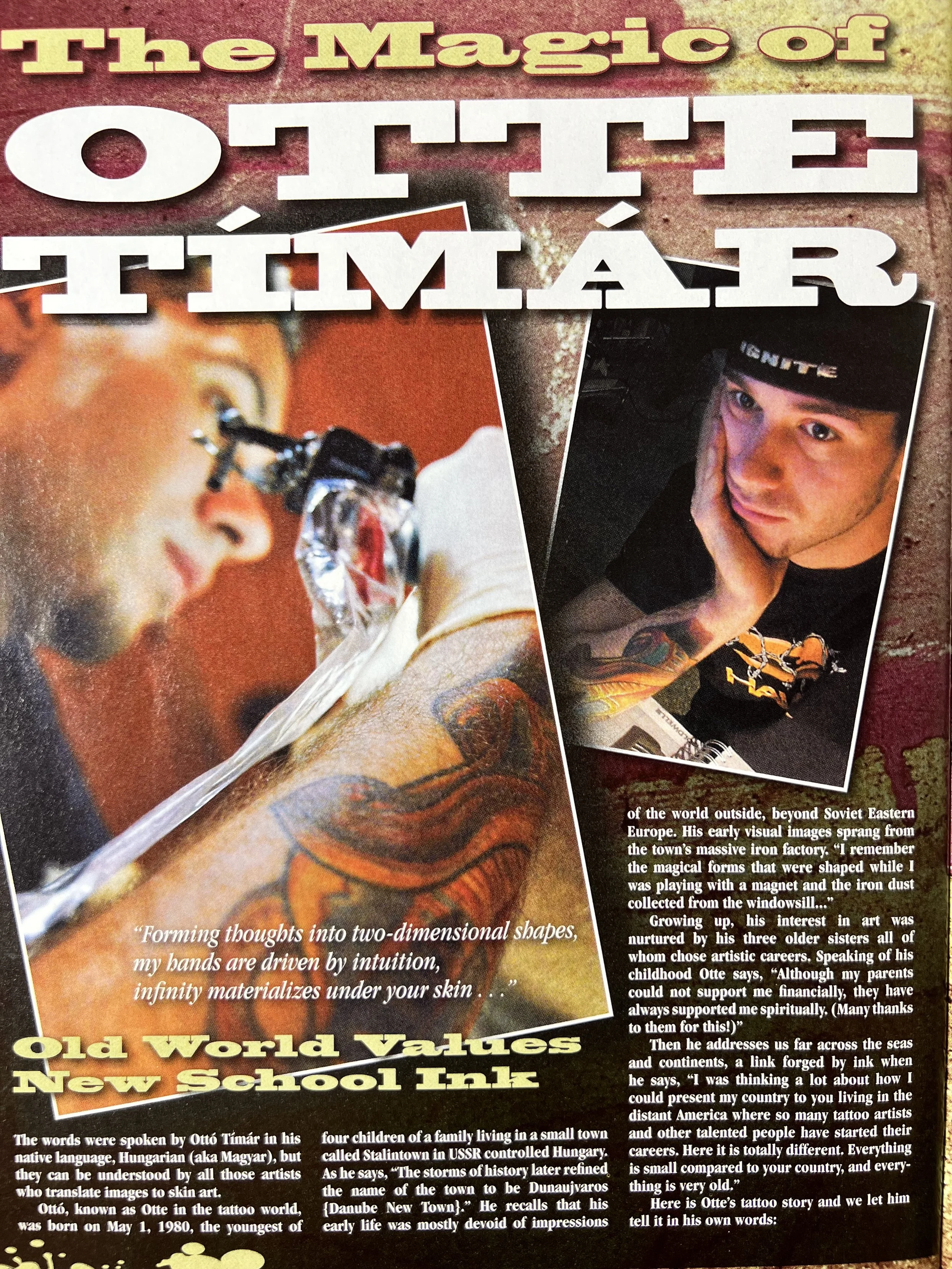
“In 2003, I headed to the pearl of the Croatian seaside, Trogir, where I spent four wonderful summers. My studio was in the attic of a 400-year-old house. Croatia had just begun to recover from the war in the '90s, and the population of the town was extremely Catholic. They had never heard of tattoo art before, and, except for a few youngsters, everyone was full of prejudices. (They believed that tattoos were common only in prisons and in whorehouses.) Luckily the Dalmatian people are very lovely people, so they eventually started to accept me and began to like me. I will never forget when an old man who lived in the neighborhood came up to my studio and told me with very bad English that I will be the next mayor of the town because people talk about us so much. It was very funny...
“I tattooed mostly tourists in Trogir, and I faced challenges only very rarely; therefore, I decided to travel again. I have been on the go since 2007, and since then I have been to most of Europa and visited German meetings continuously. I managed to reach an appreciative position in this profession in Germany, and my customers seem to like me a lot too.
“I had an interview published in your magazine in 2006, where Guy Aitchison helped me. I was rather down at that period. None of my works seemed good enough to me, which of course does not mean that I was producing sh*t, as everybody seemed content. This was more about an inner feeling that I could do better. The many congratulating emails and invitations from all over the world (thank you, guys!) helped me to get out of this downturn, and gave me new strength to go on.
“The funniest was when once I was walking in Bangkok and suddenly noticed a picture of me cut out from the Flash magazine and posted at the window of a tattoo shop. The works that you will see now are mostly from last year, but if you want to see some of my older ones, you can visit my website at www.redliontattoo.com, although I have to admit that my site needs refreshing.
“As you will see, I do not follow a definite style; I always try to be universal, though the babies of Mark Ryden did have a very big effect on me. I really like the contrast between the figures' darkness and baby faces. What you will not see among my works is anything evil. I don't like evil themes; I would rather not give this karma to anyone...
“I like to create in different ways as well. I enjoy using pastels or acrylics too, but most of the time I am on the go, so I barely have any time to do anything else. I am rather extroverted while working, and my customers enjoy themselves during tattooing. On the contrary, in my private life I am more introverted and slow; I spend a lot of time looking into myself.
“Research can extremely tie me down. I am very much interested in the ancient Hungarian mythology and religion. I believe that we modern men have lost something on the way, something that might be the key for creating a happier world. I would like to find out what this key is.
2010 — TATTOOIST ART MAGAZINE
THE LION’S ROAR: STEPPING INSIDE THE CREATIVE “DEN” OF OTTE TIMAR
Interview by: Jinxi Caddel
THE LION’S ROAR:
Stepping Inside the Creative “Den” of Otte Timar
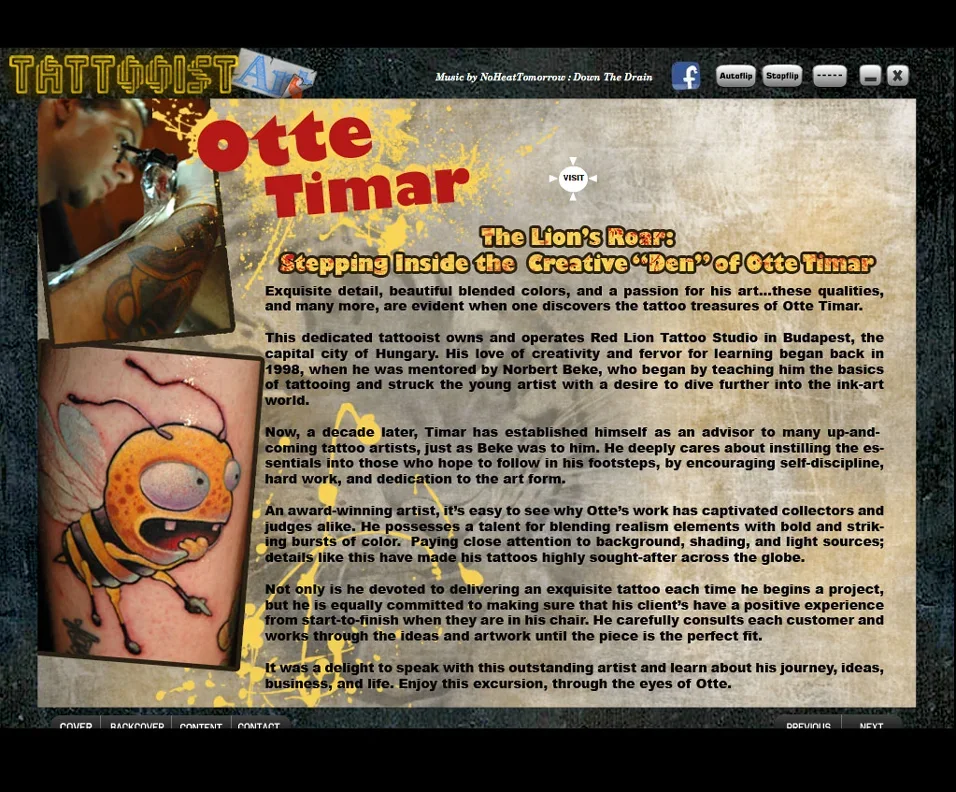
Exquisite detail, beautiful blended colors, and a passion for his art...these qualities, and many more, are evident when one discovers the tattoo treasures of Otte Timar.
This dedicated tattooist owns and operates Red Lion Tattoo Studio in Budapest, the capital city of Hungary. His love of creativity and fervor for learning began back in 1998, when he was mentored by Norbert Beke, who began by teaching him the basics of tattooing and struck the young artist with a desire to dive further into the ink-art world.
Now, a decade later, Timar has established himself as an advisor to many up-and-coming tattoo artists, just as Beke was to him. He deeply cares about instilling the essentials into those who hope to follow in his footsteps, by encouraging self-discipline, hard work, and dedication to the art form.
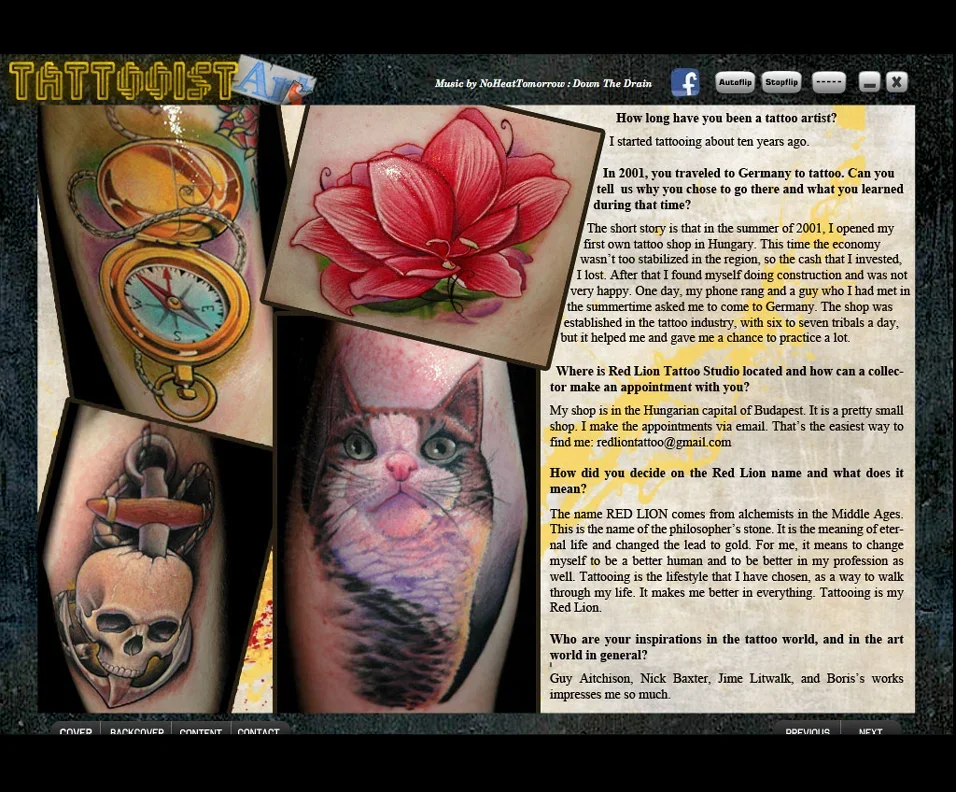
An award-winning artist, it's easy to see why Otte's work has captivated collectors and judges alike. He possesses a talent for blending realism elements with bold and striking bursts of color. Paying close attention to background, shading, and light sources; details like this have made his tattoos highly sought-after across the globe.
Not only is he devoted to delivering an exquisite tattoo each time he begins a project, but he is equally committed to making sure that his client's have a positive experience from start-to-finish when they are in his chair. He carefully consults each customer and works through the ideas and artwork until the piece is the perfect fit.
It was a delight to speak with this outstanding artist and learn about his journey, ideas, business, and life. Enjoy this excursion, through the eyes of Otte.
How did you first become interested in the tattoo world? Were you a collector first, before becoming an artist?
During the time that I first became interested in tattooing, I was living in the subculture, in Middle-Europe. I tempted my first tattoo on myself, when I got my very first machine. I did it for myself and its looks like shit.
Did you want to be an artist when you were a young boy growing up in Hungary?
No, I was older when I decided to become an artist. When I was young, in the 80's, there was communism here and tattooing was prohibited. In 1989, there was a change and during this time, the first tattoo shops were opened here in Hungary.
You learned to tattoo from Norbi Beke? Can you tell us how you met Norbi and what it was like learning from him?
Well, Norbert was the first tattooist who I met. He was a friend of my older sister's. She asked him to let me see what tattooing really meant. I would go to see him every Friday after school and had a look at what he was doing. It was unbelievably interesting for me. I would stand for four to five hours without moving and speaking; speechless. He was not a teacher-type of guy, but I learned a lot from him in the most important time, during these beginning stages.
How long have you been a tattoo artist?
I started tattooing about ten years ago.
In 2001, you traveled to Germany to tattoo. Can you tell us why you chose to go there and what you learned during that time?
The short story is that in the summer of 2001, I opened my first own tattoo shop in Hungary. This time the economy wasn't too stabilized in the region, so the cash that I invested, I lost. After that I found myself doing construction and was not very happy. One day, my phone rang and a guy who I had met in the summertime asked me to come to Germany. The shop was established in the tattoo industry. With six to seven tribals a day; but it helped me and gave me a chance to practice a lot.
Where is Red Lion Tattoo Studio located and how can a collector make an appointment with you?
My shop is in the Hungarian capital of Budapest. It is a pretty small shop. I make the appointments via email. That's the easiest way to find me: redliontattoo@gmail.com
How did you decide on the Red Lion name and what does it mean?
The name RED LION comes from alchemists in the Middle Ages. This is the name of the philosopher's stone. It is the meaning of eternal life and changed the lead to gold. For me, it means to change myself to be a better human and to be better in my profession as well. Tattooing is the lifestyle that I have chosen, as a way to walk through my life. It makes me better in everything. Tattooing is my Red Lion.
Who are your inspirations in the tattoo world, and in the art world in general?
Guy Aitchison, Nick Baxter, Jime Litwalk, and Boris's works impress me so much.
Your work is so excellent and intricate. How did you develop the style of tattoo work that you currently employ?
Thank you for the compliment. It was not a goal of mine to build a style. All artists are mirrors who reflect the things like feelings, ideas, and emotions. Some of them are cleaner, some are dirtier or distorted; but all of us are different. These different reflections are why we talk about styles. The whole thing is just the same image, but that which went through my senses and mind, and gets realized through my hands. For me, that means style. The mirror makes the style.
You have won numerous awards throughout the years for your tattoo work. Which one means the most to you and why?
The beginning of my career was really important when it came to winning awards and to became a famous tattoo artist. I have to say that it was a strong motivator for me, because it was my chance to break out from the perspective-less life of the Hungarian youths. It was an important thing during that time, but it was not what I am most proud of. Now I just try to get better all the time.
What type of project is your favorite to work on?
I love to teach rookies to tattoo. It is as fun to me as actually tattooing. I like to watch them and see, how they grown and become successful. Sometimes I'm strict, but they need it.
What type of machine/s do you use?
Micky Sharpz, Seth Ciferri, Jime Litwalk; liners from Paulo Fernando.
What advice do you have for up-and-coming tattoo artist?
The stupid media created tattoo madness. That's why so many guys just started tattooing without any knowledge or any responsibility. I try to educate about the importance of learning the basics for all the rookies, but I'm afraid that many of them do not pay attention. It seems so easy on the television, but 95% of them are going to give it up after a while. Hopefully, if they have some self-discipline. For the other 5%, I wish them all the best, because they can find a very nice way of life. I try to help them so if anybody needs help in the beginning, you just have to email me and I'm going to do my best!
What are your goals for the coming year?
I would like to visit the USA. I'm awaiting for offers from different studios.
Will you be traveling much in the near future?
I would like to spend this summer in Hungary.
What one word best describes you?
Awake.
What one word best describes your work?
Clear.
Interview by: Jinxi Caddel
2010 — JINXI BOO
TATTOO SPOTLIGHT: OTTE TIMAR FROM BUDAPEST, HUNGARY
September 22, 2010
http://www.jinxiboo.com/blog/2010/9/22/tattoo-spotlight-otte-timar-from-budapest-hungary.html
2014 — TÄTOWIERMAGAZIN
NICHT DENKEN, NUR NOCH FÜHLEN
August 2014 · 110–116. oldal
Interview: TRAVELINGMIC · Fotos: OTTE, TRAVELINGMIC
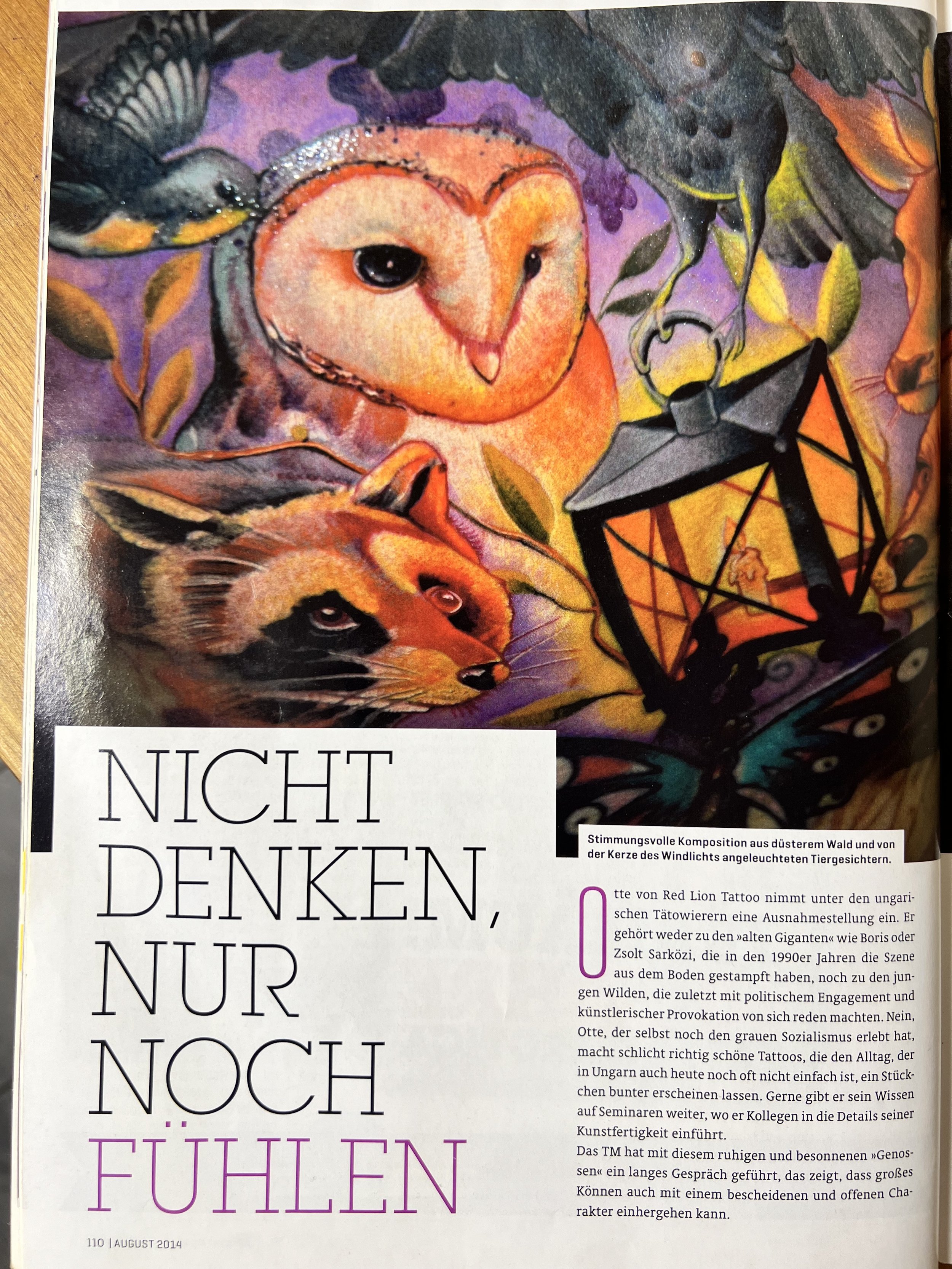
DON’T THINK, JUST FEEL
Otte of Red Lion Tattoo occupies an exceptional position among Hungarian tattoo artists. He belongs neither to the “old giants,” such as Boris or Zsolt Sárközi, who built the scene from the ground up in the 1990s, nor to the young wild ones who have recently attracted attention through political engagement and artistic provocation.
No. Otte, who himself still experienced the grey years of socialism, simply makes genuinely beautiful tattoos that add a little more color to everyday life, which even today is often not easy in Hungary. He is happy to pass on his knowledge at seminars, where he introduces fellow artists to the details of his craft.
TM had a long conversation with this calm and thoughtful “comrade,” demonstrating that great ability can indeed go hand in hand with a modest and open character.
HUNGARIAN TATTOO ARTIST OTTE OF RED LION TATTOO LETS HIS SOUL GUIDE THE TATTOO MACHINE.
Interview: TRAVELINGMIC · Photos: OTTE, TRAVELINGMIC
Doesn’t it bother you that people call you by your surname? To us it sounds a bit like something from a schoolyard: “Hey, Otte, wanna play football?”
No, no. My original name is Timár Ottó. In Hungary we write the given name after the family name. I got Otte as a nickname from my nephew when he was three years old. I simply liked it.
Your tattoos are characterized by technical precision and high aesthetic quality. Do you have any formal artistic training?
No, thank God I don’t. Otherwise my path would have been completely different.
PROFILE
Age: Old enough to have experienced socialism. I was born on May 1st, Labour Day. When I was a child, my parents always told me that all the parades were being held in my honour.
Born in: Dunaújváros.
Lives in: Visegrád. A mystical and historic place about 30 kilometres from Budapest. It looks like a setting from The Lord of the Rings.
Works in: Visegrád and on the road; currently often in Munich (Identity Tattoo), Simbach am Inn (Inferno Tattoo) and Vienna (Boris Tattoo). Starting in autumn, I’m planning a larger tour with several guest spots in Germany and I’m still looking for studios for it.
Tattooing for: 15 years. Norbert Beke, one of the true old hands of tattooing in Hungary, allowed me to look over his shoulder. I’m still very grateful to him for that today.
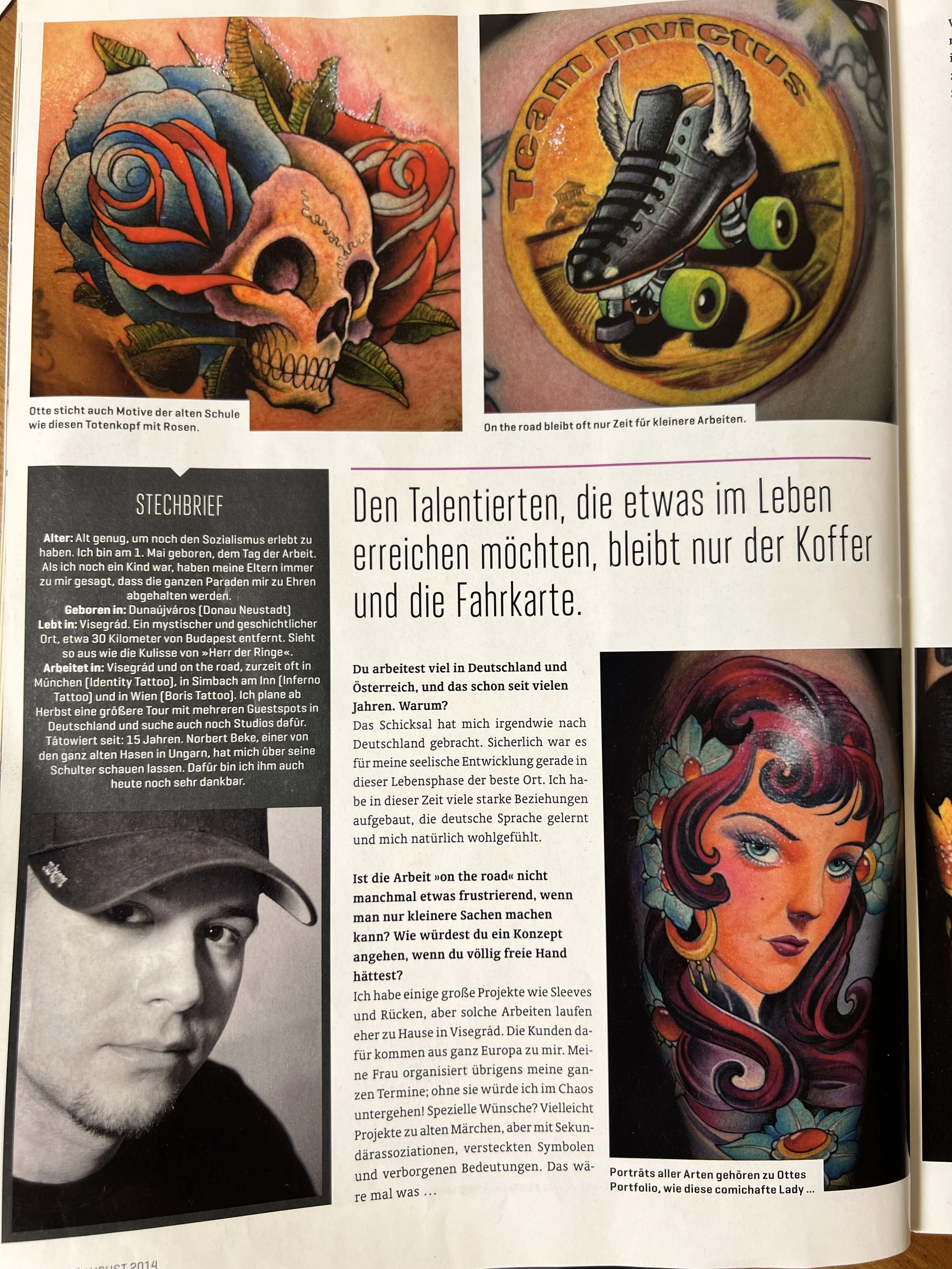
“For talented people who want to achieve something in life, all that remains is the suitcase and the ticket.”
You work a lot in Germany and Austria and have done so for many years. Why?
Fate somehow brought me to Germany. It was certainly the best place for my spiritual development at that particular stage of my life. During that time I built many strong relationships, learned the German language and, of course, felt comfortable there.
Isn’t working “on the road” sometimes a little frustrating when you can only do smaller pieces? How would you approach a concept if you were given completely free rein?
I have several large projects such as sleeves and backs, but those kinds of projects tend to be done at home in Visegrád. Clients come to me from all over Europe for them. Incidentally, my wife organizes all my appointments; without her I would descend into chaos!
Special wishes? Perhaps projects based on old fairy tales, but with secondary associations, hidden symbols and concealed meanings. Now that would be something…
How do you see the situation in Hungary now? Have many tattoo artists who went abroad returned in the meantime? Does the Hungarian scene suffer because many established and talented artists have emigrated?
Hungary is a country with a beautiful past. But since the 20th century, something has gone terribly wrong here. Today we are nothing more than a colony ruled by globally operating corporations. In this country – as in every colony in the world and throughout history – there are few prospects for the slaves.
For talented people who want to achieve something in life, all that remains is the suitcase and the ticket. Naturally, the scene suffers because of this, but I hope and believe that Hungary will one day become a rich country again, and then German tattoo artists will of course be very welcome to come and work here as guest workers…
That really does make you think about whether we will be able to preserve our relative prosperity. Something else: we see each other every year in Budapest. Has this convention, which is now well established, helped create more cooperation among Hungarian artists?
Oh yes, Budapest is a really good convention with a huge number of unknown but extremely talented artists. Really serious work is shown here, good designs, no little bullshit. I looked around again this year and my jaw dropped when I saw what the younger generation is doing! And the atmosphere is right as well; we are moving closer together.
My impression is that there are many young people in the Hungarian scene today who are good friends, enjoy working together and also spend their free time together. Is that right?
Basically, yes, but please don’t imagine the Hungarian tattoo scene as some kind of hippie commune where one person plays the guitar while the others dance around holding incense sticks!
Of course there are conflicts between people here as well. But something magical happens nevertheless: when two tattoo artists meet, regardless of whether they personally like one another or not, they will still talk openly and honestly about their art and technique, and they share all their information and tips.
Perhaps that is the secret of our strength.
“For larger projects, clients are happy to come to me from all over Europe.”
That may well have something to do with how difficult it used to be to get the right information and good technique. You make many tattoos in a very aesthetic, appealing, “beautiful” style. Does that mean you have comparatively many women among your clients?
My clientele is actually very mixed; I can’t say with certainty whether I have more female clients. And I do many different things in a wide variety of subject directions.
The aesthetic works that made me known, in turn, attract those clients who like that direction. That makes me very happy, because personally I love tattoos like these, which are also a pleasure for the eyes.
Where does your own artistic self-expression lie within your tattoos? What truly comes from deep inside you when you tattoo and are given the freedom not merely to copy an image?
I like it when I find the right flow and the tattoo unconsciously turns out to be exactly what the client wanted.
The highest creative and spiritual state is when you no longer have to think and can simply feel.
That is why I like listening to lectures and enjoy audiobooks, to keep one part of my mind occupied. Then my soul can guide the machine.
That is how I achieve the best result, and when someone later asks me how I managed to do a particular thing, I have no idea… Honestly!
Are provocation and political or social statements part of your work?
Yes, sometimes, but most of the time I prefer to remain with pure aesthetics. I think the roles of artist and service provider cannot be separated.
The best tattoo artist can handle people just as well as he handles his machine on the skin. The key to art – and to success – is humility.
Your tattoos have very good durability, especially considering the many colors you use. Is there a technical secret you can share with us? Or is it simply a matter of patient and precise work?
You need an intimate knowledge of the skin and a great deal of concentration.
With that combination, you can get as much pigment as possible beneath the skin. Sometimes I go over the same area eight or nine times.
You have to be extremely careful not to injure the skin, which, as I said, requires experience and concentration. Contours and contrast are also important in order to give the tattoo a frame.
That is what makes a tattoo long-lasting. Achieving that has always been one of my most important goals.
And you achieve it exceptionally well. Otte, thank you very much for the interview!
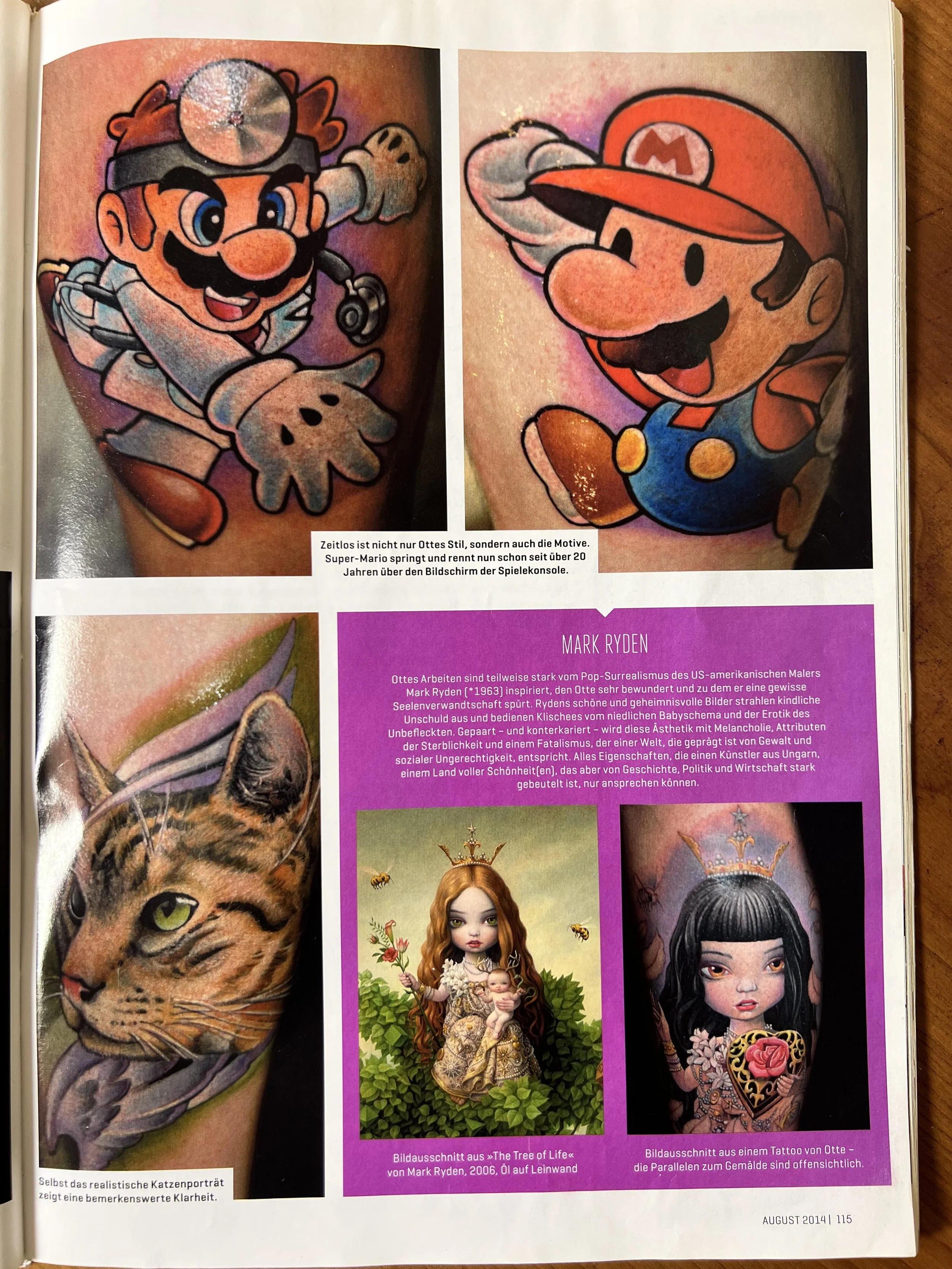
MARK RYDEN
Otte’s work is partly strongly inspired by the Pop Surrealism of American painter Mark Ryden (*1963), whom Otte greatly admires and with whom he feels a certain spiritual affinity.
Ryden’s beautiful and mysterious images radiate childlike innocence while drawing on clichés of cute, baby-like features and the eroticism of the immaculate. This aesthetic is paired – and contrasted – with melancholy, attributes of mortality, and a fatalism corresponding to a world marked by violence and social injustice.
All of these are qualities that can only resonate with an artist from Hungary, a country full of beauty that has nevertheless been heavily battered by history, politics and economics.